Governed supervised learning
E-commerce Conversion ML
Focuses on responsible model selection: accuracy is reported alongside feature availability, calibration, uncertainty and drift diagnostics.
Measured project results
- public e-commerce sessions
- 12,330
- deployment-safe ROC-AUC
- 0.7602
- test bootstrap resamples
- 500
- tests across model and API behavior
- 16
Metrics come from the committed reproducible run in the linked repository. Their interpretation and limits are documented below.
Architecture
System flow and reviewable outputs.
- 01
Versioned UCI dataset
- 02
Schema and split controls
- 03
Pipeline model comparison
- 04
Feature-availability ablation
- 05
Calibration and cost policy
- 06
Monitoring, API and dashboard
Reviewable artifacts
- Model pipelines
- Ablation study
- Calibration
- Drift monitoring
- FastAPI
- Docker
- Tests and CI
Technology stack
- Python
- scikit-learn
- FastAPI
- Pydantic
- Docker
- Streamlit
Question
What the project investigates.
Estimate a session conversion probability without presenting a potentially end-of-session feature as safely available for early scoring. The result must also expose uncertainty, calibration and policy trade-offs.
Approach
Method, in order.
- 01
Download the public dataset with a manifest and validate schema and ranges.
- 02
Use a stratified 60/20/20 train-validation-test split and preprocessing inside pipelines.
- 03
Compare prevalence, logistic and histogram gradient boosting baselines with cross-validated tuning.
- 04
Run a PageValues ablation before defining the deployment-safe candidate.
- 05
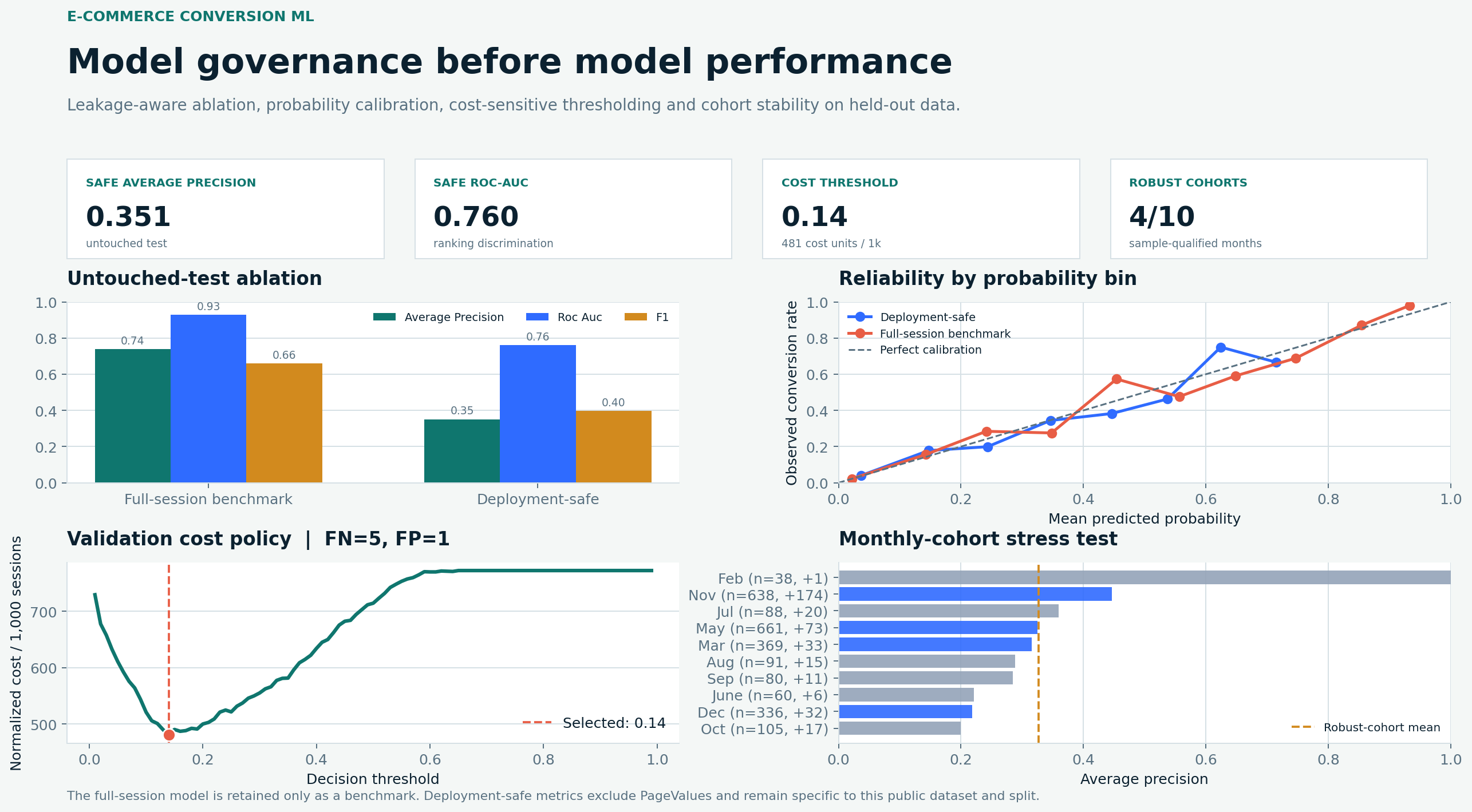
Calibrate on validation, define F1 and normalized-cost thresholds, then evaluate an untouched test with bootstrap intervals.
Evidence
Results with context.
- The full-session benchmark reaches 0.9293 ROC-AUC, but the portfolio treats it as a performance ceiling rather than an early-scoring deployment candidate.
- The deployment-safe model reaches 0.7602 ROC-AUC, 0.3513 average precision and 0.1163 Brier score on the untouched test.
- The repository exposes PSI drift references, cohort stress checks and FastAPI contracts alongside the dashboard.
Quality controls
How the work can be reviewed.
- Feature availability is treated as a modeling requirement, not a post-hoc caveat.
- The serialized bundle records its numerical environment for compatibility review.
- Pytest, Ruff and GitHub Actions cover pipelines, metrics, calibration, costs, drift and API endpoints.
Limits
What the output is not.
- The UCI data provides month only, so it cannot support a true chronological holdout.
- Cost units are a transparent analytical scenario, not observed company economics.
- PSI signals distribution change but does not by itself prove a performance decline.